

About the project

Figure 1: Schematic representation of the main advantages of droplet technology
Antimicrobial resistance is one of the most urgent challenges in modern medicine, yet current diagnostic methods still require many hours, or even days, to determine whether a bacterial infection is susceptible to a given antibiotic. This project aims to overcome that limitation by developing a pilot technology capable of assessing bacterial drug resistance in under 60 minutes, using the unique advantages of droplet microfluidics.
Droplet microfluidics enables the creation of hundreds of thousands of picolitre‑scale bioreactors, each functioning as an isolated microenvironment where a single bacterial cell can be encapsulated, cultured, and monitored. This extreme miniaturization dramatically increases throughput while reducing the time needed to observe early biological events. The key benefits of this approach: high reaction density, single‑cell resolution, and precise chemical control, are illustrated in Fig. 1 .
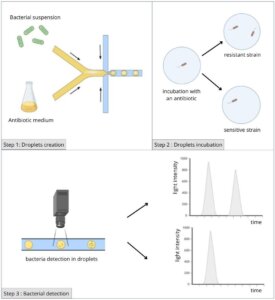
Figure 2: Diagram showing the general protocol, including droplet creation, their incubation, and bacterial detection
Building on preliminary work demonstrating the detection of small bacterial populations in 100 pL droplets, the project seeks to push sensitivity further, ideally to the level where light scattering from individual cells can be detected. Achieving this would make it possible to observe the very first bacterial divisions, allowing a rapid determination of whether growth continues in the presence of an antibiotic.
The general workflow is shown in Fig. 2 . Bacteria are encapsulated into monodisperse droplets, incubated briefly, and then passed through a microfluidic detection system where ultra‑fast optical measurements capture the scattering signal generated by the cells. In the optimal scenario, each cell produces a detectable scattering event, enabling the system to distinguish between inhibited and growing populations after only one or two divisions.
By integrating high‑throughput droplet generation, sensitive optical detection, and advanced data analysis, the project aims to create one of the fastest phenotypic antibiotic susceptibility tests available. The resulting technology is designed to deliver clinically relevant minimum inhibitory concentration (MIC) values for multiple antibiotics simultaneously, with the speed and precision required for real‑world diagnostic applications.